

SCBTS
- Home
- Scheme for Capacity Building in Textile Sector (SCBTS)
Scheme for Capacity Building in Textile Sector (SCBTS)
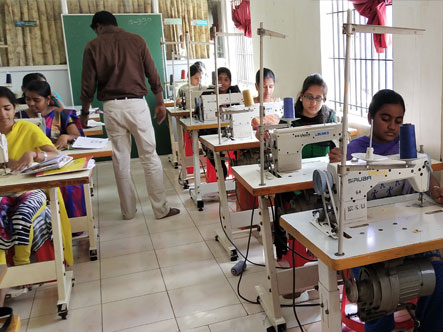
SCBTS (Scheme for Capacity Building in Textile Sector) shall be known by the "Samarth", the scheme to skill the youth gainful and sustainable employment in the textile sector.
Selection of trainees:
The selection process for identifying the trainees shall be transparent and inclusive. The trainee must be a citizen of India possessing an Aadhaar Card with age over 14 years.
Aadhaar Based Biometric Attendance:
Mandatory Aadhaar Enabled Biometric Attendance System integrated with centralized MIS will be adopted to ensure real time attendance of the trainers and the trainees.
Trainers and Training of Trainers (ToT)
Each of the training centers will be run by a qualified trainer and support staff. The capacity of the trainers shall be enhanced through a comprehensive Training of Trainers (ToT) Programme.
Course Content
The content for each course/programme shall be need-based to meet the highest standards and requirements of the related industry segment, including awareness about labour laws, and will be designed by the Textiles Committee (RSA) in consultation with the industry.
Soft Skills
In addition to the targeted domain specific hard skills, the programme shall also aim at imparting soft skills (life management skills) to the trainees. The training center’s provide minimum 30 hours of soft skills training, including but not limited to communication abilities, language skills, personal habits, cognitive or emotional empathy, time management, team work and leadership traits.
Assessment and Certification
A third party assessment of the trainees will be conducted by the Assessment Agencies empanelled by the RSA. After assessment of the candidates, based on the marks obtained, a certificate with the following grades will be given:
| MARK SCORED | GRADE |
|---|---|
| >85% | A |
| 70%-85% | B |
| 60%-69% | C |
Placement and Post Placement Tracking
Employment Linkages
The Training Centers would take all steps to partner with industry and obtain the commitment of industrial units for employment of the successfully trained candidates
Placement
There shall be 70% placement of the successful trainees under the scheme For the courses in the organized sector, all 70% should be in wage employment. However, in case of traditional sector (Handloom, Handicraft, Silk & Jute), atleast 50% should be in wage employment with balance in self-employment, in-line with the Common Norms. After the assessment, the TC will ensure placement of successful candidates within 3 months of completion of training. In case of wage employment, candidates should be placed in jobs that provide wages atleast equal to the minimum wages prescribed and such candidates should continue to be in job for a minimum period of three months. In case of self-employment, candidates should be gainfully employed in livelihood enhancement occupations. This may be established through documentary evidence e.g. trade license for setting up of an enterprise or becoming a member of producer group or loan documents for loan taken to set up own business or proof of additional earnings (through bank statement).
In case of self-employment, besides documentary evidence as per above term, a self- declaration by the candidate confirming his self-employment will be provided by the IA. Further, the TC will be required to facilitate availability of concessional credit under the Pradhan Mantri MUDRA Yojana to such candidates.
Post Placement Tracking
Each trainee will be tracked by the TC for a period of one year from the date of certification of training. The TC will be required to upload the details of placement and tracking on MIS every month along with the supporting documentary proof. An innovative system for tracking will be developed in MIS that shall use technology (web & mobile based) for the trainees to respond on their own to the tracking system. The parameters for tracking would be as under:
Remuneration
Whether continues to work in the same or higher job role till end of the tracking period (whether with same or different employer).
If there are periods of un-employment between different jobs, duration of such gaps and reason for leaving earlier job without having a job in hand./p>
Monitoring and Management Information System (MIS)
The field offices of the Ministry viz. office of DC(Handloom), DC(Handicraft), Textile Commissioner, Jute Commissioner and Central Silk Board etc. will undertake physical verification of Training Centers (TC).
The verification of training centers’ infrastructure, including evaluation of training center’s capacity for target allocation will be carried out as per the course-wise criteria defined by RSA for approved NSQF courses.
Monthly visits for inspection of live training center’s will also be carried out. Mobile Application with features of Geo-tagging will be used for verification of the TC and uploading of reports on MIS, on a real-time basis.